

DATE
Ground proof-of-principle Experiment Success for Formation-Flying Unwired Phased-Array Antenna
CATEGORY
TAG

- Interstellar Technologies announced the successful completion of a proof-of-principle experiment to construct a formation-flying unwired phased-array antenna using satellites as array elements.
- This proof-of-principle experiment investigated a novel scheme scalable to systems comprising 10,000 to 100,000 satellites for inter-satellite information exchange and timing alignment.
Tokyo (Japan), December 22, 2025 – Interstellar Technologies (“Interstellar”), a leading space infrastructure company, is pleased to announce the successful completion of a ground-based proof-of-principle experiment to construct a formation-flying unwired phased-array antenna using satellites as array elements. The experiment was conducted in collaboration with Shirane Laboratory (Institute of Science Tokyo), Honma–Murata Laboratory (Iwate University), and Microwave Factory Co., Ltd. This achievement supports the development of next-generation high-speed communications satellites capable of enabling direct-to-device (D2D) connectivity with smartphones, connected vehicles, other mobility systems, and IoT devices.
The results of this work have been accepted for presentation at IEEE ISSCC 2026 (February 15–19, 2026; USA), widely recognized as the world’s premier conference in solid-state circuits and semiconductor technology.
Interstellar is advancing formation flying technology, in which ultra-small satellites precisely coordinate their positions and attitudes, to enable high-speed, high-capacity broadband satellite communications with direct-to-device (D2D) connectivity to ground-based devices.
Since 2024, the company has been conducting fundamental research commissioned by Japan’s Ministry of Internal Affairs and Communications (MIC) under the program “Research and Development for Expansion of Radio Spectrum Resources” (JPJ000254), in collaboration with Japanese universities.
In formation flying, 10,000 to 100,000 ultra-miniature satellites can be precisely coordinated to operate as a single, large-scale high-gain array antenna. By combining signals from numerous small antenna elements, the array enables weak received signals to be coherently combined into a stronger signal, while transmitted signals are integrated to achieve higher effective radiated power.
This Formation-Flying Unwired Phased-Array Antenna can be significantly larger and achieve much higher gain than conventional space antennas. Unlike traditional array antennas, whose elements are electrically interconnected through physical wiring, the satellites acting as antenna elements in a formation-flying system are physically separated. As a result, inter-element connections must be established wirelessly, requiring the development of new integration and synchronization methods to enable the entire formation to operate as a single, coherent antenna.
It should be noted that this approach is different to the well-established Distributed Antenna System (DAS), primarily used to enhance indoor and outdoor coverage, improve communication quality, and distribute system capacity. The Formation-Flying Unwired Phased-Array Antenna differs fundamentally in both purpose and architecture. Interstellar approach achieves antenna gain through tight synchronization of antenna elements and coherent signal combining. Accordingly, this project develops a distinct architecture, referred to as an “unwired phased-array antenna.”
In this proof-of-principle experiment, Interstellar investigated a novel scheme scalable to systems comprising 10,000 to 100,000 satellites for inter-satellite information exchange and timing alignment, and prototyped analog signal-processing ICs and antennas suitable for ultra-miniature satellites. Using an array of multiple simulated satellites, the company demonstrated cellular signal transmission and reception. While still small-scale, this demonstration using actual hardware, from transmission through reception, is a major milestone toward practical, large-scale implementation. Interstellar will continue improving performance, reliability, and scalability.
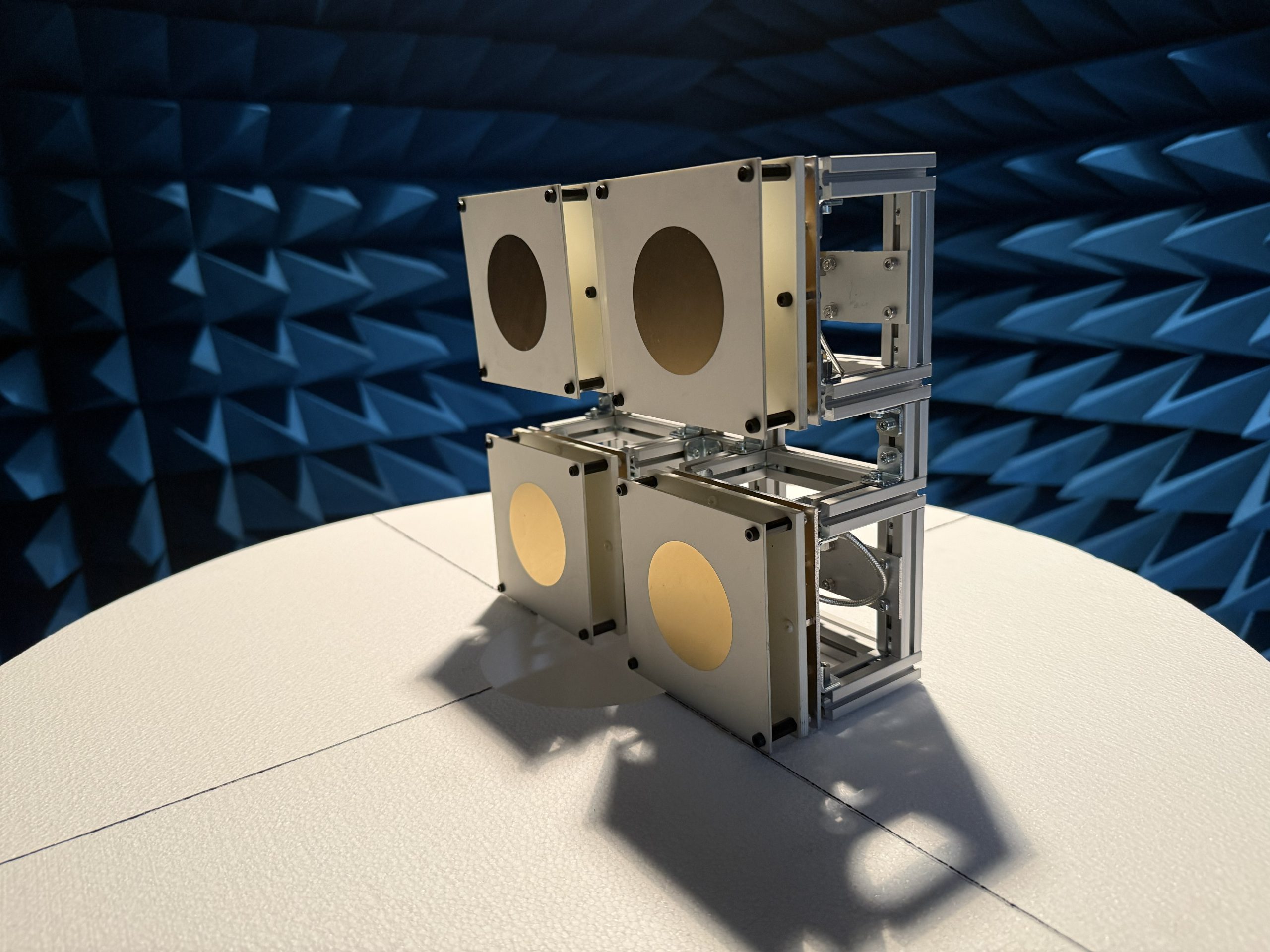
Experimental apparatus: A setup simulating multiple satellites. An antenna is mounted at the center of each satellite, and integrated circuits are mounted inside each satellite.
About IEEE ISSCC 2026 Presentation
Conference: IEEE IInternational Solid-State Circuits Conference(ISSCC) ( https://www.isscc.org/)
Presentation Session: Session 5 Sub-THz and mm-Wave Phased Arrays and Beamformers
Title: A Formation Flight Phased-Array Transceiver for Spatial Power Combining and Distributing Architectures in Direct-to-Device-Communication Satellite Constellations
Authors: K. Yuasa*1, Y. Takahashi*1, S. Watanabe*1, S. Kato*1, S. Ema*2, G. Hattori*2, A. Naka*3, S. Morioka*3, T. Inagawa*3, K. Murata*4, N. Honma*4, J. Mayeda*1, A. Shirane*1
*1 Institute of Science Tokyo, Tokyo, Japan
*2 Microwave Factory, Kanagawa, Japan
*3 Interstellar Technologies, Hokkaido, Japan
*4 Iwate University, Iwate, Japan